Should you wait for the Samsung Galaxy Watch 4? I’ve been tracking next-generation Galaxy Watch leaks ever since the Samsung Galaxy Watch 3 came out. And from what I’ve seen so far, longtime fans of the flagship wearable and first-time smartwatch users alike have an attractive gadget to look forward to.
In fact, with rumored upgrades like blood glucose monitoring and a major OS switch, the Samsung Galaxy Watch 4 could be the best smartwatch ever for Android users. But without a release date in sight, you might be wondering whether this new watch will be worth waiting for.
Instead, you could get the Galaxy Watch 3 right now. Not only can you find it on sale, but it’s a little more than six months old. It’s still the biggest competition to the Apple Watch Series 6, and the top accessory pick for owners of Samsung phones.
Here are the top things you should consider if you’re wondering whether to wait for the Galaxy Watch 4 or get the Galaxy Watch 3 now.
Wait: The Galaxy Watch 4 release date is less than six months away
According to a Twitter thread from tipster Ice Universe, the Galaxy Watch 4 and perhaps a fitness-focused Galaxy Watch Active 4 are due in the second quarter of 2021. This means Samsung could be launching its newest smartwatch models earlier than usual — the Samsung Galaxy Watch 3 debuted in August 2020.
But even if the next Galaxy Watch comes in August like its predecessors, it’s still less than six months away from making a debut. If you want to avoid buyer’s remorse (or buy a Galaxy Watch 3 now only for the Galaxy Watch 4 to introduce upgrades you care about,) practice a little patience.
Wait: You’re interested in blood glucose monitoring
A report from ETNews revealed that the Samsung Galaxy Watch will offer non-invasive blood glucose monitoring. Apparently Samsung has been working on this technology for some time.
It works using a technique called Raman spectroscopy. The smartwatch would employ a laser to help identify the chemical composition of glucose through the skin. As described in a method developed by Samsung researchers, the laser offers high prediction accuracies.
Not only is this a game-changer for people with diabetes, but fitness-minded people who track how sugar intake impacts performance could find use for on-demand blood glucose readings, too.
Don’t wait: The rumored upgrades aren’t relevant to you
That said, if blood glucose monitoring isn’t relevant to your health needs, you probably won’t be wowed by the wellness upgrades coming to the next Galaxy Watch. You can expect to see more of the same: SpO2 monitoring, VO2 max readings, automatic activity tracking, trip detection and ECG vital measurements.
So if that sounds like more tools that you’d ever use, the Galaxy Watch 3 already has everything you need. Sure, there might be minor performance or cosmetic enhancements in Samsung’s plans, but nothing compelling enough to make you regret a purchase now.
Don’t wait: You want a new smartwatch right now
This might seem obvious, but you shouldn't wait for the Samsung Galaxy Watch 4 if you're interested in a new smartwatch right now. Whether you've aged out of your current smartwatch or decided you want a smartwatch for the first time, you should go ahead and get the Galaxy Watch 3. Especially now that you can find it for $70 off at most retailers.
Of course, you could get a different smartwatch entirely. Any of the best fitness trackers are good options if you're looking for some wrist-based encouragement to get in shape, too. The Fitbit Sense is a solid compromise, offering phone call support for Android users.
But there is no better smartwatch right now for Samsung smartphone users specifically than the Galaxy Watch 3. I expect that'll change when the Galaxy Watch 4 gets closer to launch. Once we have a better idea of its release date, this buying advice could change.
In the meantime, be sure to bookmark our Galaxy Watch 4 guide for the latest news and rumors concerning Samsung's next-generation smartwatch.
Images of Samsung’s unannounced Tab A7 Lite tablet have leaked, courtesy of Evan Blass on Voice. The images show a decidedly budget-looking device, with a single rear camera and no flash. Internally the tablet is said to be running a modest MediaTek Helio P22T processor paired with 3GB of RAM and a 5,100 mAh battery.
The Tab A7 Lite is one of two “Lite” tablets Samsung is expected to launch in June, if a February leak from WalkingCat is to be believed. The other is the Galaxy Tab S7 Lite, which features a bigger 12.4-inch display compared to 8.7-inches on the A7 Lite, according to WalkingCat. GalaxyClub.nl previously reported the S7 Lite may be available with 5G or Wi-Fi-only connectivity, and that it could be powered by a Snapdragon 750G processor with 4GB of RAM. Available colors are said to include pink, green, black, and silver.
The two Lite tablets follow their full-fat counterparts from last year. Both the Tab S7 and the Tab A7 benefited from great displays and speakers, making them excellent for general media consumption. While neither were as well-suited to productivity tasks, that might not matter for the upcoming tablets if they’re priced affordably enough.
Ushering in a new era in television technology, Samsung's Mini LED-sporting QN900A Neo QLED 8K TV offers stunning picture quality, exceptional color and brightness, terrific sound and outstanding blacks – all in a package that's unmatched in terms of design.
For the uninitiated, Samsung's 'Quantum' Mini LEDs are 1/40th the thickness of a regular light-emitting diode, meaning thousands of smaller LEDs can be packed together in a much tighter fashion, allowing for far more accurate dimming zones and black levels that are practically indistinguishable from an OLED to this reviewer's eyes.
Of course, that doesn't mean Samsung's Neo QLED is to able to produce lights and colors at the individual pixel-level like an OLED TV can, only that it does a comparable job when it comes to contrast.
Outside of its new lighting technology, the QN900A excels in terms of picture quality, with an astonishing 8K resolution display that does a brilliant job of upscaling 1080p and 4K content thanks to the AI-based 'Neo Quantum Processor 8K'.
Gamers are bound to love the QN900A, thanks to a number of next-gen ready features, including support for 4K/120fps or 8K/60fps gameplay via HDMI 2.1, Game Motion Plus and AMD FreeSync Premium Pro.
It probably goes without saying that the QN900A's pricing will prove prohibitively expensive for most people – particularly the 85-inch model reviewed here. However, those of you with money to spend who are looking for the current benchmark in top-end televisions will find very little to fault with Samsung's QN900A Neo QLED 8K TV.
Price and availability
65, 75 and 85-inch models set to release
New technology means premium pricing
Available to pre-order now, expected to launch May 2021
Samsung QN900A Neo QLED 8K TV specs
Screen Sizes: 65, 75, 85-inches | Tuner: Freeview Plus | 8K: Yes | HDR10: Yes | HLG: Yes | Dolby Vision/Atmos: No/No | Panel technology: Mini LED (LCD) | Smart TV: Samsung / Tizen OS | Curved: No | Dimensions: 2140 x 1872 x 1053mm (85-inch without stand) | Weight: 43kg (without stand) | 3D: No | Inputs: 4xHDMI (2x HDMI 2.1, 2x 8K @ 60fps compliant) (1xeARC), 3xUSB, 1xRF, ethernet | Outputs: 1x optical
With the arrival of its QN900A range, Samsung has essentially stepped into a new television category, giving its already high-end 8K displays a rather significant Mini LED upgrade. Because of this, Samsung's Neo QLED 8K lineup doesn't come cheap.
The QN900A range starts at $4,999 for a 65-inch model (£5,999 / AU$7,579), while larger models see it go up to $6,999 (£7,999 / AU$10,499) for the 75-inch, and $8,999 (£11,999 / AU$13,999) for the 85-inch, which is the one we've reviewed.
Samsung's QN900A Neo QLED 8K TV range is available for pre-order now at selected retailers and via Samsung's online store, with an expected on-sale window of May 2021.
An up-close look at the QN900A's ultra-thin bezel.(Image credit: TechRadar)
Design
Gorgeous bezel-free design
Minimal stand with attachable One Collect box
Anti-glare coating not super effective
When viewed for the first time, it's hard not to gush over the QN900A's stark minimalism, which aims to make everything but the content you're watching melt away from view.
The first thing you'll notice (or maybe not notice) is the TV's nearly non-existent bezel, which has been reduced to less than a millimeter (0.9.mm) – an achievement made possible by a new and exclusive matrixing technology that's said to shrink the space between where the pixels at the edge of the display end and where the bezel begins.
The next thing you'll probably wonder is where the QN900A's speakers are, as they're not visible from front-on. In fact, the TV's speaker grilles can be found along its left and right edges, housing an 80W 6.2.2 channel system (that's ten speakers in total).
The QN900A's speaker grills are only visible from the side.(Image credit: TechRadar)
Continuing the trend of aesthetically pleasing design elements is the QN900A's stand, which is slim, flat and centered, meaning you won't need an especially wide surface to place the TV on.
Like all of Samsung's premium televisions for the last few years, the QN900A aims to reduce cable clutter by having a separate One Connect box that houses all but one of the TV's ports.
This is still a convenient alternative to awkwardly plugging several cables into the back of the TV itself (especially if you plan to wall-mount the unit), and the QN900A offers the added bonus of being able to attach the One Connect box directly to the back of the stand if you don't have a good hiding spot for it.
HDMI 2.1 is supported across all four of the TV's HDMI ports, with one also offering eARC support, and there's also 3x USB 2.0 ports, 1x ethernet port, 1x optical output and an RF antenna input.
Samsung's One Connect box mounted to the QN900A's stand.(Image credit: Future)
If there's one design area we can fault, it's that the QN900A's screen can be quite reflective in well-lit rooms. Though the TV boasts an anti-reflection layer, we found it nearly impossible to take a picture of the set's black levels without the light from a nearby window reflecting back at us.
Aside from this, Samsung's QN900A Neo QLED 8K is a television that's class-leading when it comes to design. With bezels that have been reduced to the point of nearly non-existent, speaker grills that are only visible from the side, and a minimalist stand that also provides additional functionality, the QN900A's design is what every TV manufacturer should aspire to.
A view of the QN900A's stand from the front.(Image credit: Future)
Smart TV (Tizen OS) and remote
Fast and familiar Tizen-based operating system
Most popular apps readily available
Remote no longer needs batteries
If you've owned or used a Samsung TV in the last few years, you'll know more or less what to expect from the QN900A's smart Tizen-based OS.
A press of the home button on your remote will see your favorite apps and sources pop up from the bottom edge of the display in a horiztonal line.
Cycling through these will see additional information spring up above the initial row of apps. For instance, hovering over a streaming service like Netflix will present you with a view of your recently viewed shows and movies, allowing you continue directly from your home screen.
(Image credit: TechRadar)
All the most popular apps and services are present and accounted for on Samsung's OS, and there's a dedicated Apps tile with further app suggestions which you can install.
Additionally, the QN900A's remote offers a couple of dedicated buttons that allow you to quickly launch Netflix and Amazon Prime Video.
In terms of design, the Neo QLED 8K's remote is quite similar to what Samsung's been offering with its other TVs over the last few years, with one major difference – the new remote no longer needs batteries, with a new panel on its rear that's able to absorb light – both natural and artificial – to keep itself charged up.
The choice to ditch batteries is not only great for the environment, it's also made the remote itself incredibly light in the hand. That said, you will have to get used to placing the remote face down when you've finished using it.
(Image credit: TechRadar)
Performance
Excellent clarity and color
Brightness that far exceeds what OLEDs are capable of
OLED-like contrast with none of the drawbacks
As we mentioned earlier, Samsung Neo QLED televisions sport LEDs that have been reduced to 1/40th of their traditional size, allowing for a huge increase to both brightness and black levels.
As the LEDs are far smaller, they're able to achieve far more precision and less blooming, so the act of seeing bright areas of the screen unnaturally bleed over into darker spots should be greatly reduced or not evident at all.
We kicked things off by watching the stunning documentary series Our Planet on Netflix. Immediately, we were treated to a view of Earth from the moon, with a wide expanse of tiny, glittering stars surrounded by the deep blackness of space. That we could make out these individual specs without light bleeding around them was more than impressive for a non-OLED display.
Skipping forward a bit, we found ourselves viewing a lush, green rainforest against a backdrop of picturesque mountains. The detail here was off the charts, with an intense clarity that looked sensational given its 4K source, proving that there's no real hurry for native 8K content to arrive.
(Image credit: TechRadar)
The next thing we booted up was Robert Rodriguez's visually spectacular epic Alita: Battle Angel in 4K Ultra HD. Once again, we were impressed by how sharp and clean the film looked on the QN900A, offering an incredible amount of detail, rich colors and deep blacks.
It's worth mentioning that we did notice some instances of light bleed in one scene near the beginning of the film, in which Alita is looking over her new mechanical body.
In the image below, you'll see some light bleeding from her bright chest plates into the black bar at the bottom of the screen. Of course, we didn't really notice this elsewhere, and it must be said that the highlights in this scene are especially bright. Still, it does show that even with Mini LEDs that light bleeding can still occur.
(Image credit: TechRadar)
One of the big selling points of any 8K TV is how well it handles upscaling. and thankfully the QN900A does a great job of making content look crystal-clear without any artificial smoothing. Take the above image of Alita as an example – it's clean and sharp, yet you can still make out its fine, film-like grain.
Taking advantage of Samsung's Multi-Intelligence AI upscaling, the QN900A was consistently able to produce images that looked better than their source. We're not saying that it made any 4K content look like native 8K, but it did make it appear better than Ultra HD when viewed up close.
(Image credit: TechRadar)
On 8K TVs, pixels are much closer together, and therefore much more difficult to individually make out than on 4K sets. In our tests, we watched content from a variety of sources, including 480p episodes of Gargoyles on Disney Plus and 1080p episodes or Brooklyn Nine-Nine on Netflix in order to see how the QN900A's upscaling fared.
While there's not a lot that can be done with older standard definition content these days, we were glad to see that it didn't look especially stretched out or fuzzy on this massive 8K screen.
Modern 1080p content, however, looked excellent. Taking into consideration that one FHD pixel is stretched across 16 pixels on an 8K TV, Samsung's AI-powered Neo Quantum Processor 8K chip is necessary to stitch together these additional pixels in a way that's clean and natural looking, without any aliasing or fuzziness to speak of.
While we weren't able to test any 4K/120Hz content during our review period, we did take a look at a number of 8K/60fps test videos and found the QN900A delivered consistently smooth motion with nary a hiccup to speak of (outside of a couple of instances where our Wi-Fi wasn't able to keep up).
Audio
Surprisingly great built-in audio
Object-tracking effect good, if not quite 3D
Soundbar still the best way to achieve truly immersive sound
Although we were provided with Samsung's new Q950A soundbar for the purposes of our review, we chose to limit our usage of it in an effort to get a better understanding of the Neo QLED's built-in sound offering.
As discussed earlier, the QN900A's speakers have been integrated into the left and right sides of the TV. You won't find audio shouting out of the back of this television, but Samsung's much-touted Object Tracking Sound Pro feature does a good job of bringing depth to whatever you happen to be watching, making it easy to track noises moving from left to right.
While there was some dimensionality to be found here, the telly's built-in speakers couldn't hope to match a real Dolby Atmos-capable soundbar or hi-fi setup when it comes to a providing a truly convincing three-dimensional soundscape.
Despite this, Samsung's top-of-the-line Neo QLED 8K TV offered far better audio performance than we were expecting, with dialogue coming through in a particularly clear and prominent fashion.
Buy it if…
You want the best TV currently out there Boasting the latest in Mini LED lighting technology, exceptional picture quality and impressive sound, Samsung's QN900A Neo QLED 8K is the new benchmark in televisions.
You want the best looking TV on the market With its near-invisible bezel and speakers, and its stunning and minimalist stand, the QN900A is one seriously gorgeous television. Now it's up to competing manufacturers to catch up.
You want a television that's future-proofed Not only does the Samsung QN900A Neo QLED 8K TV offer the latest HDMI 2.1 and eARC features, it's also idea for gamers who've recently invested in a next-gen console or beastly gaming PC.
Don't buy it if…
You're trying to save money Given that it boasts the latest Mini LED lighting technology, unrivalled design and all the latest high-end features, it should come as no surprise that Samsung's QN900A Neo QLED 8K is seriously expensive – even for the smallest option. Avoid if you're trying to save up.
Your viewing environment is especially bright Despite boasting an anti-glare coating, the screen on Samsung's QN900A is quite reflective, picking up reflections from lamps, downlights and nearby windows during our review period.
If you're thinking about swapping your Android phone in to join the legions of iPhone users around the world, Apple has made the transition a bit simpler.
According to MacRumors, Apple now allows customers to trade in Google Pixel 4a, Pixel 5, and Samsung Galaxy Note 10 devices for credit toward new Apple products.
The trade-in program would allow customers to send in their Pixel 5 for $350 toward a new Apple product, or to trade a Pixel 4a for $180 in credit. Those sending in a Galaxy Note 20 would receive a whopping $425 in credit. That's nearly half the amount you could pay for a new Galaxy Note 20 outright, so the takeaway here is that you won't be missing out on too much if you decide you no longer want to be Team Android and want to change allegiances.
Apple does note that some of the trade-in values will change, of course, depending on the device's condition when traded in. For those with potential scratches and dents or non-functioning phones, there will be less credit than there would be if the phone were in pristine condition. This is almost universally true of many phone providers. The less inherent value to a phone when it's surrendered, the less value it has to the provider, especially since you're being given a new device in return.
Recommended by Our Editors
These credits aren't localized to the ones listed above, however. Apple has also updated the trade-in value of most of the other Android phones it accepts. Additional information can be found on Apple's trade-in page, but if you're looking to transition, now might be the best time to do so.
The Samsung Galaxy S21+ 5G is the middle child in Samsung's latest family of flagship smartphones, and it's cheaper than ever.
Samsung
It’s the final day of Samsung’s week-long Discover Spring Event, but there is still one juicy sale to be had. Each day has featured a new deal, like earlier in the week when we saw huge bargains on the Galaxy Note 20, Galaxy Watch 3 and more. And today, Samsung is issuing an extra $250 off the price of a new Samsung Galaxy S21+ 5G. Normally starting at $1,000, you’ll get the discount in the form of instant rebates at checkout. You can save even more by trading in a device toward it. It’s possible to get your total as low as $150 if you do.
That’s not all. In addition to the dust sucker, Samsung is offering 10% off all purchases in three categories: home appliances (which includes refrigerators, washers and dryers, vacuums, microwaves and air purifiers, to name a few), mobile devices (phones—including other Samsung phone deals, earbuds, smartwatches) and computer monitors.
Speaking of appliances, Samsung is throwing in free installation on select home appliances and entertainment products during the sale, as well as free haul-away and disposal on all home appliances.
There’s one other reason to check out the sale, and it helps if you’re feeling lucky—every purchase awards an entry in Samsung’s contest that includes prizes up to $5,000. To enter, make a purchase at Samsung anytime between March 22 and March 28, and you’ll be automatically entered into the drawing, which commences April 8. First place is $5,000, but there will also be three second place winners earning $3,000 each and a half-dozen $1,000 third-place winners.
Looking to upgrade to Samsung's newest flagship phone? The Galaxy S21 family arrived back in January and thanks to Samsung's Spring Sale event, the middle child is already pretty deeply discounted. Today only, the Samsung Galaxy S21+ is marked down by $200 and comes with a $50 instant credit—a total savings of $250.
The Galaxy S21 Plus adds some extra real estate to the screen. It features a 6.7-inch AMOLED display versus the S21's stock 6.2-inch screen. You get Full HD+ resolution (that's 2400x1080 pixels) at 1,500 nits of peak brightness and refresh rates up to 120Hz. All that adds up to a sharp display with smooth video that also conserves battery life. Want more resolution? There's always the S21 Ultra.
There are a lot of improvements under the hood, notably the inclusion of 5G wireless, which includes the fastest “millimeter wave” version of the service for when that finally lands in your neighborhood. The S21+ camera is the same as the one you'll find in last year's S20, though. Again, you'll need to step up to the S21 Ultra if you want to be on the bleeding edge with the new 108-megapixel camera. Even so, the cameras you do get are nothing to scoff at: dual 12MP sensors for wide-angle shots and a 64MP telephoto that takes photos at up to 30X zoom.
Don't forget, though: This is the last day of Samsung's sale and is your only chance to get the S21 Plus for $250 off–at least, until the next time it lands on sale, whenever that may be.
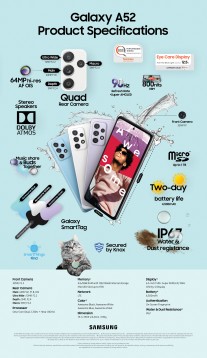
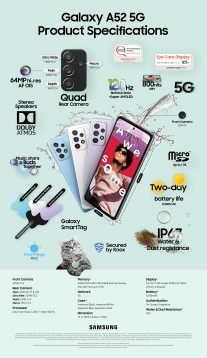
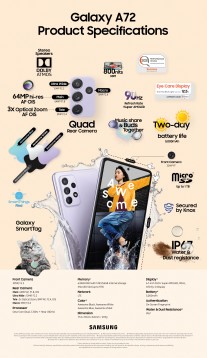
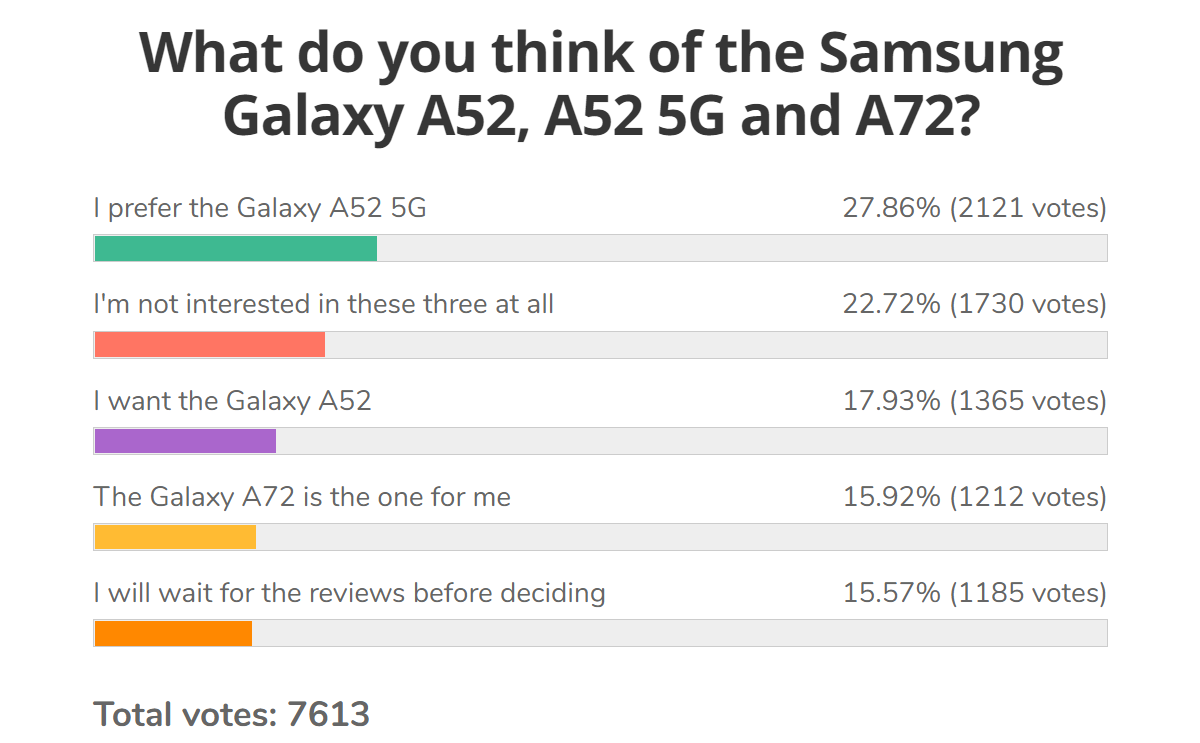
Samsung has successfully tuned the Galaxy A-series to people’s preferences. The A52 in particular is going to be quite popular, both flavors of the phone were well received in last week’s poll.
The Samsung Galaxy A52 5G came out on top, showing that next-gen connectivity is an important consideration for many. Compared to its 4G twin, it also has an upgraded chipset (Snapdragon 750G vs. 720G) and a higher refresh rate for its screen (120Hz vs. 90Hz).
Infographics with the key details: Galaxy A52 • Galaxy A52 5G • Galaxy A72
The 4G version of the Galaxy A52 proved fairly popular in its own right. The extended software support (3 years of OS updates, 4 years security patches) is a major draw and can easily justify the price premium over competing models. Plus, both Galaxy A52s feature OIS on their main camera, which some of the competition lacks.
The Samsung Galaxy A72 proved the least popular option of the three. That 3x telephoto lens should have been its trump card, but ultimately it didn’t amount to much. Right now, it looks like 5G is more important than optical zoom. Samsung will probably release a 5G version of this phone (even the A32 has a 5G version), which will fare a lot better than the Galaxy A72 4G.
samsung.indah.link “Marketplace” is among the shows available on the Samsung Free service.
American Public Media is a publishing partner for the Samsung Podcasts service available in the new “Listen” tab of Samsung Free content/app service.
“Through this partnership, APM audio content is now available on the Samsung Podcasts service, on compatible Galaxy smartphones,” APM said in its announcement.
“Starting today, Samsung Podcasts enables Galaxy users to discover and listen to a huge selection of today’s most popular podcasts, including popular shows from APM’s library, such as ‘Marketplace,’‘Don’t Ask Tig’ and ‘Brains On!’”
Samsung Podcasts are in the new Samsung Free platform, which gives users access to live TV, headlines and games. Samsung Free and Samsung Podcasts are available on compatible Galaxy S21, Galaxy S20, Galaxy Note20, Galaxy S10 and Galaxy Note10 devices.
APM’s Thomas De Napoli, managing director, multiplatform sales strategy & business development, American Public Media, said the move “is an excellent way for us to reach even more young and diverse audiences on a global scale.”
Subscribe
For more stories like this, and to keep up to date with all our market leading news, features and analysis, sign up to our newsletter here.